Food2025-26
NetronEats – Building a Scalable Multi-Tenant Food Ordering SaaS Platform
Next.jsNode.jsSupabaseTypeScriptStripeDojo OnlinePaypalElavon
Overview
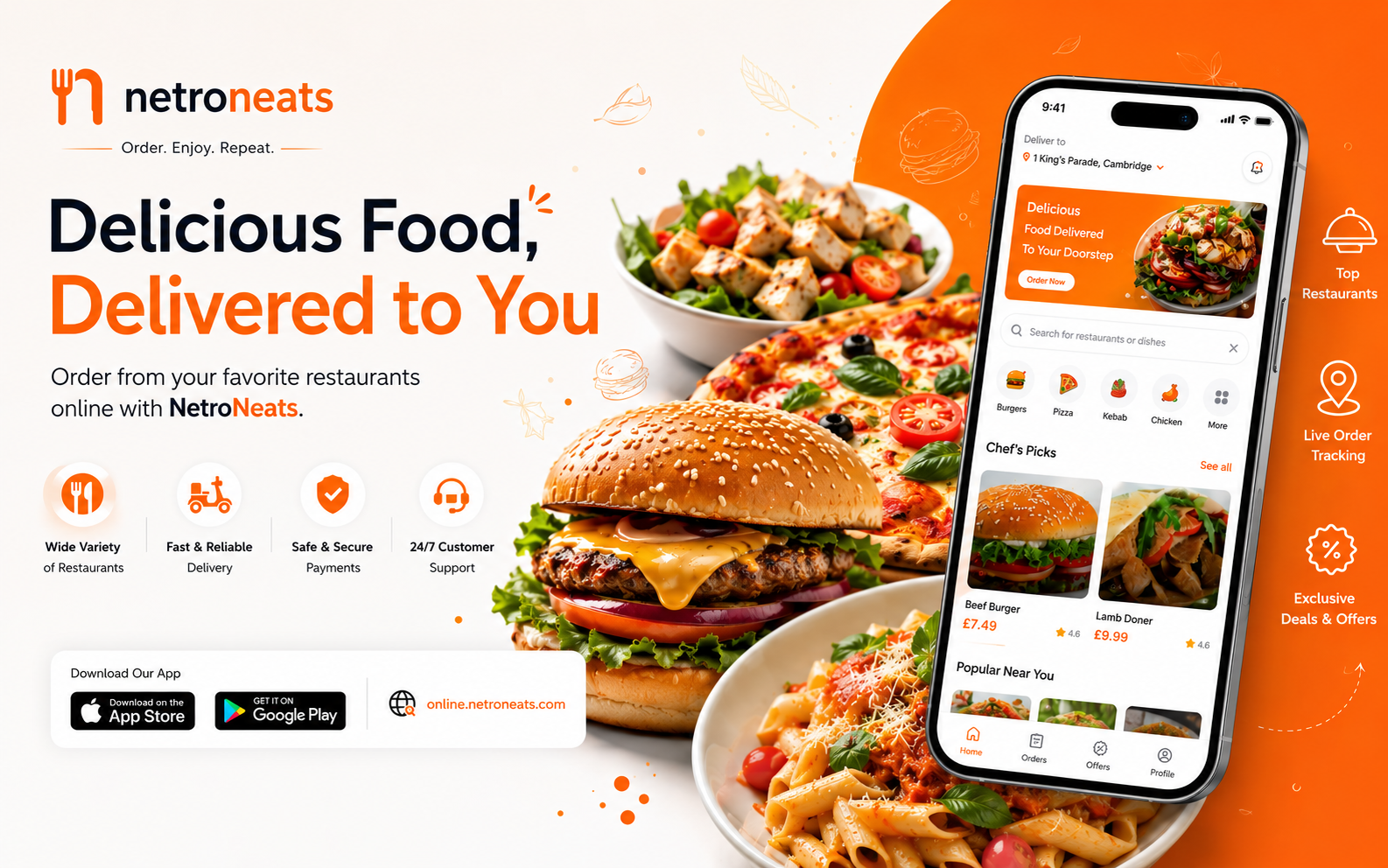
When the NetronEats project began, the vision was ambitious: create a modern SaaS platform that would allow restaurants to operate their own branded online ordering system while being managed from a single scalable infrastructure. Instead of developing individual websites for every restaurant, the goal was to build one platform capable of serving hundreds—and eventually thousands—of restaurants with different menus, payment providers, languages, and business workflows.
I joined the project as the Full-Stack Engineer responsible for designing and developing the customer-facing web platform. My responsibility was to build a fast, scalable, and SEO-friendly application using Next.js, while developing the backend services with Node.js and Supabase.
Today, the platform powers 100+ restaurants across the United Kingdom and continues to process real customer orders every day.
The Challenge
The restaurant industry has very different operational requirements compared to a traditional e-commerce website.
Each restaurant needs:
Its own menu
Custom opening hours
Delivery zones
Table reservation management
Pickup and Eat-In ordering
Online payments
Order tracking
Multiple languages
High availability during busy meal hours
On top of that, everything needed to work from a single SaaS platform without restaurants affecting one another.
The challenge wasn't simply building another food ordering website—it was designing an architecture that could scale while remaining easy for restaurant owners and customers to use.
Planning the Architecture
Before writing code, I focused on designing an architecture that would support long-term growth.
The technology stack was selected with scalability and developer productivity in mind:
Next.js for a fast, SEO-optimized frontend
Node.js for backend APIs and business logic
Supabase (PostgreSQL) for authentication, database management, and secure data access
The application was designed around a multi-tenant architecture where every restaurant operates independently while sharing the same infrastructure.
This approach significantly reduces maintenance costs while making onboarding new restaurants quick and efficient.
Building the Customer Experience
The customer application became the core of the platform.
The primary objective was to create an experience that feels effortless—from discovering a restaurant to completing an order.
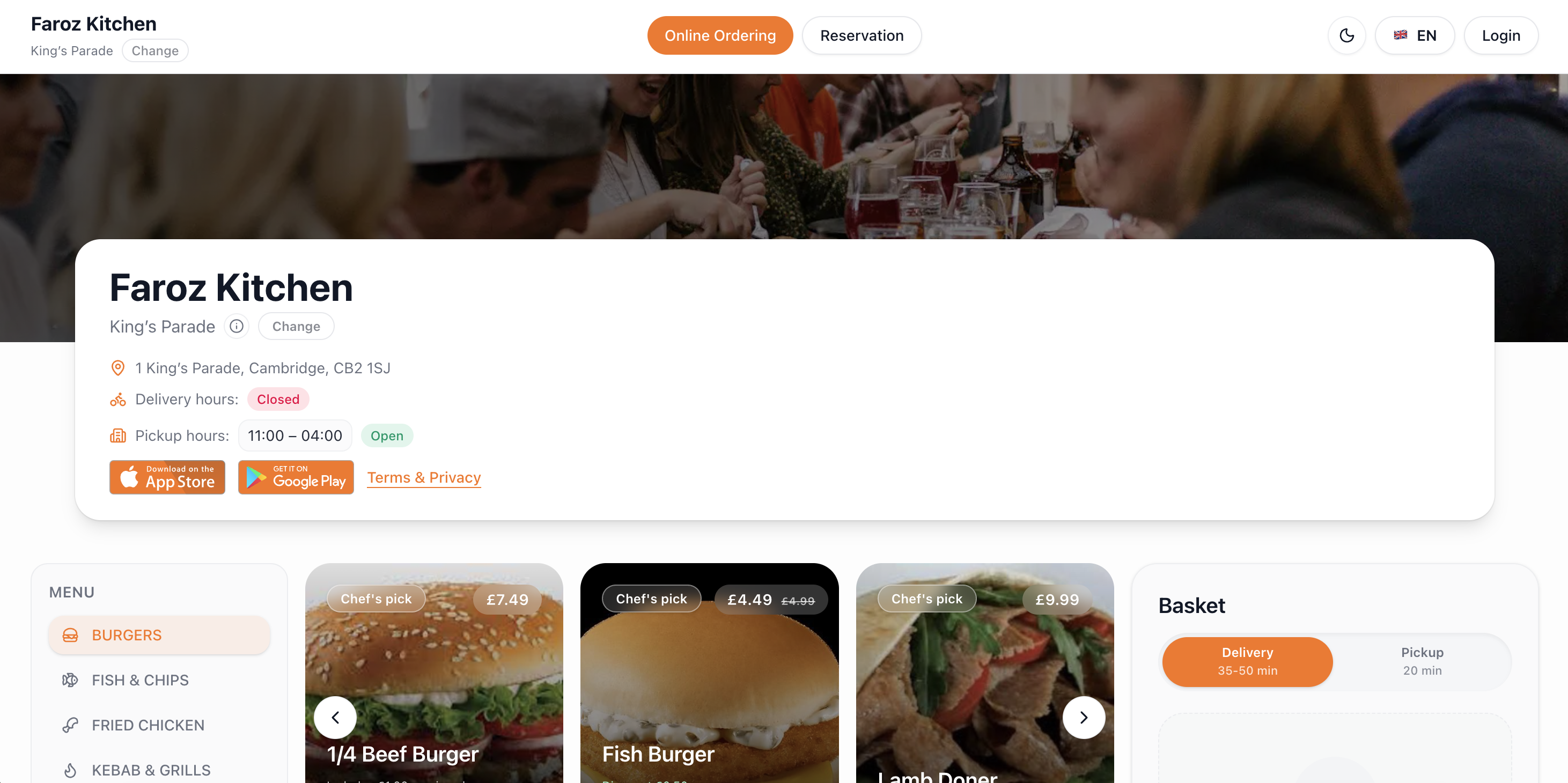
Customers can:
Browse restaurant menus
Search products
Customize food items
Add items to their cart
Schedule deliveries
Place pickup orders
Reserve tables
Order for Eat-In
Track their orders
View previous purchases
Manage their accounts
The interface was built to be fully responsive, ensuring a smooth experience across desktop, tablet, and mobile devices.
Performance was also a major priority. Using Next.js allowed pages to load quickly while maintaining excellent SEO, helping restaurants gain visibility in search engines.
Supporting Multiple Languages
One of the project's key requirements was internationalization.
The platform was designed so that users could browse the application in multiple languages without changing the underlying business logic.
Every customer-facing section—from menus and checkout to notifications and account management—was built with multilingual support in mind, allowing the platform to grow into additional markets beyond the UK.
Building Flexible Ordering Workflows
Unlike many ordering systems that only support delivery, NetronEats had to accommodate several different customer journeys.
I implemented support for:
Home Delivery
Pickup
Eat-In
Table Reservations
Each workflow has different validation rules, checkout processes, and operational requirements.
Designing these as reusable modules kept the codebase clean while making it easier to introduce future ordering methods.
Payment Gateway Integration
Restaurants often have preferred payment providers, making payment flexibility essential.
Instead of integrating only one gateway, I developed an extensible payment architecture capable of supporting multiple providers.
The platform currently integrates with payment services including:
Stripe
Dojo Online
Elavon
Additional regional payment gateways
This modular approach allows restaurants to choose the provider that best suits their business without requiring changes to the core platform.
Connecting the Restaurant Ecosystem
The customer website is only one part of the larger ecosystem.
The platform integrates seamlessly with:
A Restaurant Management Dashboard built in FlutterFlow
A Restaurant POS System developed by another team
Whenever customers place an order through the website, restaurants receive it instantly through their management systems, enabling staff to accept orders, prepare food, update statuses, and manage daily operations in real time.
My work focused on ensuring the web platform communicated reliably with these systems through well-structured backend APIs.
Backend Development
Behind the user interface is a backend designed for reliability and scalability.
Using Node.js and Supabase, I developed services responsible for:
Restaurant management
Menu management
Product management
Customer authentication
Order processing
Reservation handling
Payment processing
Business validation
Secure API communication
Supabase provided PostgreSQL, authentication, and Row-Level Security, helping ensure that each restaurant could only access its own data.
Performance and Scalability
Since restaurants experience significant traffic spikes during lunch and dinner hours, performance was treated as a first-class requirement.
Throughout development I focused on:
Fast page rendering
Efficient API responses
Optimized database queries
Responsive user interactions
SEO optimization
Secure authentication
Maintainable code architecture
These decisions allowed the platform to remain stable as more restaurants joined the system.
My Role
As the Full-Stack Engineer on the project, I was responsible for:
Designing and developing the complete customer-facing web application
Building backend services using Node.js
Designing the Supabase database architecture
Implementing the multi-tenant SaaS model
Developing multilingual functionality
Integrating multiple payment gateways
Building Delivery, Pickup, Eat-In, and Table Reservation workflows
Developing authentication and authorization
Creating APIs for communication with the restaurant dashboard and POS
Optimizing performance, scalability, and SEO
Supporting production deployments and ongoing improvements
Technologies Used
Next.js
React
Node.js
TypeScript
Supabase
PostgreSQL
REST APIs
Stripe
Dojo Online
Elavon (Many other)
Internationalization (i18n)
Results
NetronEats has evolved from an initial concept into a production-ready SaaS platform that powers more than 100 restaurants across the United Kingdom.
The platform enables restaurants to manage online ordering, table reservations, payments, and day-to-day operations through a single scalable ecosystem, while customers enjoy a fast, multilingual, and seamless ordering experience.
For me, this project was much more than building a website—it was about engineering a scalable digital infrastructure capable of supporting the real-world operations of modern restaurants and positioning the platform for future expansion into new markets.