sports2025-26
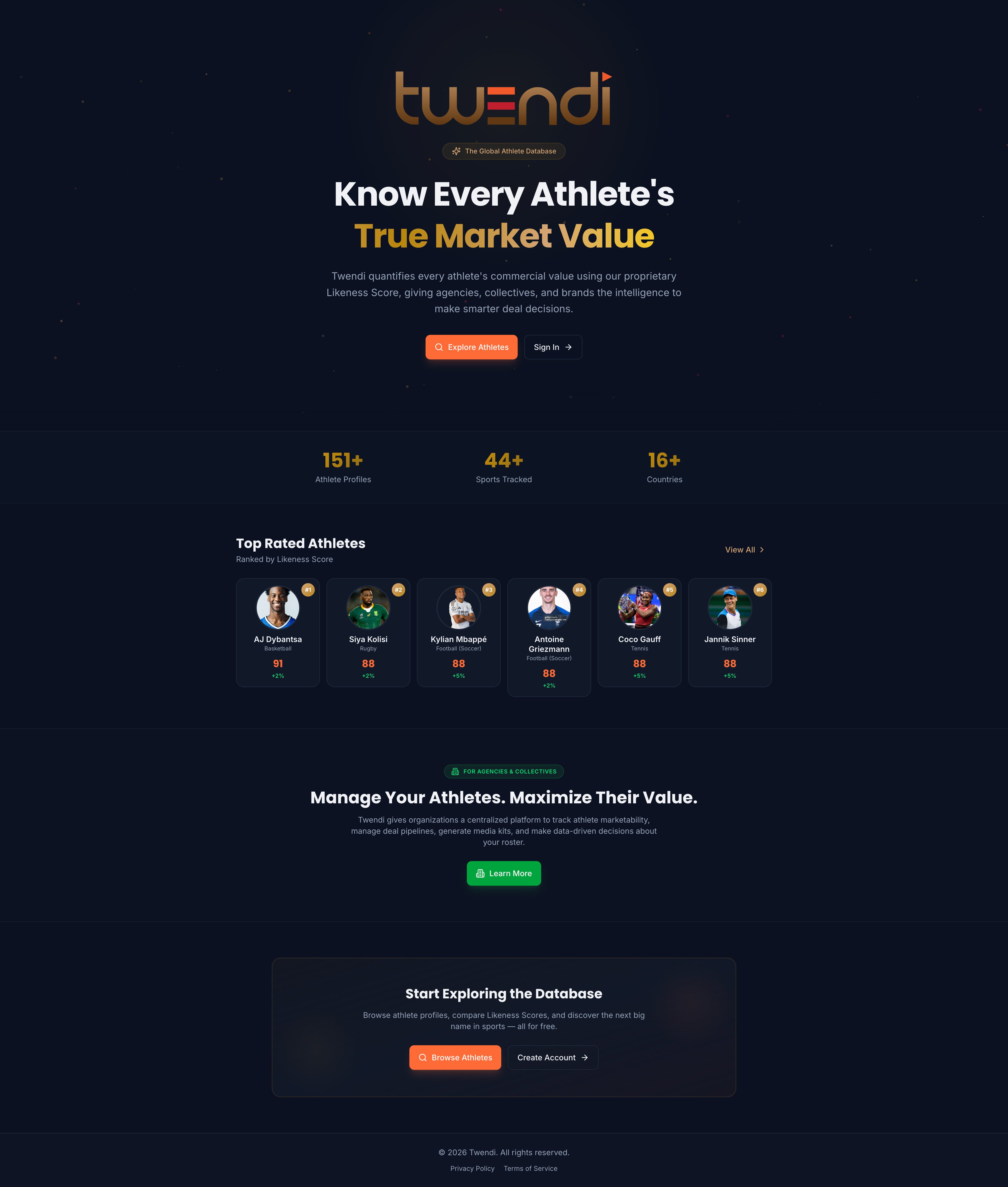
Twendi - Multi-Role SaaS athlete discovery and campaign platform
Next.js 16Node.jsExpress.jsSupabaseRedisSocket.ioMongoDBWebhooks
Project Overview
Twendi is an athlete discovery and collaboration platform designed to connect athletes, brands, and fans in a structured ecosystem. The platform allows brands to discover athletes, initiate campaigns, manage offers and deliveries, and collaborate through real-time communication.
The goal of the MVP was to transform an early concept — originally a simple Framer-based UI — into a scalable, production-ready web application capable of supporting real workflows between multiple user roles.
The system was designed with four independent dashboards:
Athlete Dashboard
Brand Dashboard
Fan Dashboard
Admin Dashboard
Each role has clearly defined responsibilities and permissions, making Twendi a multi-tenant, role-driven SaaS application.
Platform Overview
Problem Statement
When the project began, the client:
Had only a basic UI prototype
Did not have clear functional requirements
Had no defined workflow between athletes and brands
Required iterative discovery during development
The challenge was not only technical — it was also product definition.
The MVP needed to:
Define how brands interact with athletes
Structure campaign and offer flows
Enable real-time communication
Provide analytics and approval workflows
Remain scalable for future expansion
Solution Approach
I adopted an Agile development approach, starting with UI validation before backend implementation.
Development Strategy
Convert conceptual UI into functional flows
Validate each module with the client before backend work
Build modular APIs for flexibility
Introduce real-time architecture early
Optimize for scalability instead of shortcuts
This allowed continuous feedback while preventing major architectural rewrites later.
System Architecture
Frontend
Next.js 16 (App Router)
Cache Components
SEO-driven architecture
Server/Client component separation
Dynamic filtering and search
Backend
Node.js + Express.js REST APIs
Supabase PostgreSQL
Supabase Storage (Media Assets)
Role-based access flows
Real-Time Layer
Socket.io for real-time messaging
Redis for event handling and chat performance
Background Processing
CRON jobs
Agenda (Job Queue)
Scheduled processing and async operations
Communication
Nodemailer
EJS email templates
Google Workspace SMTP
Platform Modules
1. Athlete Dashboard
Athletes can:
Create and complete profiles (minimum 90% completion required)
Submit profile for admin approval
Receive approval or rejection with feedback
View dashboard analytics:
Campaigns
Offers
Earnings
Followers
Communicate with brands via real-time chat
Submit campaign deliveries for approval
Workflow example:
Brand → Discussion → Campaign → Multiple Offers → Deliveries → Approval → Payment
2. Brand Dashboard
Brands can:
Create and manage profiles
Search athletes using filters
Follow athletes
Initiate real-time conversations
Create campaigns
Send multiple offers per campaign
Approve or request delivery changes
Track analytics
3. Fan Dashboard
Fans have simplified access:
Discover athletes
Follow athletes
Build engagement metrics
4. Admin Dashboard
Admin controls include:
Athlete approvals/rejections
Platform moderation
Data management
System oversight
Public Platform Features
Home landing page
Athlete discovery page with advanced filters
Dedicated sport pages
Country analytics pages
FAQ, Privacy Policy, Terms
SEO optimized routing
Key Technical Challenges
1. Undefined Requirements
The biggest challenge was that requirements evolved during development.
Solution:
Frequent review cycles
UI-first validation
Agile iteration
Modular backend design
This prevented costly rewrites later.
2. Scope Management
New features were frequently requested outside the original agreement.
Approach:
Delivered reasonable improvements when beneficial
Maintained professional boundaries for out-of-scope work
Ensured project timeline stability
This reflects real-world MVP development challenges.
3. AI Recommendation System (Unexpected Requirement)
During development, the client requested personalized recommendations.
Learned and integrated OpenAI initially
Later migrated to Gemini as requested
Built working prototypes
Eventually the feature was removed due to budget constraints.
Outcome:
Feature removed professionally
Architecture preserved
Gained experience in AI integrations which later influenced future work
4. External QA Coordination
The client hired an external QA team.
Challenges included:
Slow testing cycles
Mostly UI/UX feedback rather than functional issues
Coordination delays
Solution:
Iterative fixes
Clear communication loops
Stable release management
Performance & Architecture Decisions
Key MVP decisions that improved scalability:
Redis for real-time events instead of database polling
Background job processing via Agenda
Next.js caching for performance
Modular API structure for future microservices migration
Supabase for rapid MVP delivery with strong database reliability
Results
Platform successfully launched: 31 January 2026
Delivered within ~3 months development cycle
Fully functional multi-role ecosystem
Real-time campaign collaboration system
Production deployment completed
Post-launch support continued for one month.
Client feedback (5-star rating):
“Overall, the experience was good, but there is room for improvement. The project went well, however I had to repeatedly ensure alignment with the original contract. Some unnecessary features were added, extra tasks were requested outside scope, and the testing team hired by Adam was slower than expected.”
This reflects a real production environment where scope and expectations evolve — and demonstrates professional project delivery under changing requirements.
Key Takeaways
This project demonstrates:
✅ Ability to convert unclear ideas into structured products
✅ Full MVP architecture planning
✅ Real-time systems implementation
✅ Multi-role SaaS development
✅ Backend + frontend ownership
✅ Professional handling of scope changes
✅ Adaptability to changing technical directions
Why This Case Study Matters for MVP Clients
Twendi proves the ability to:
Build complex MVPs from early-stage ideas
Define workflows when requirements are unclear
Deliver scalable architecture from day one
Handle evolving product requirements professionally
This makes the development approach ideal for startups and founders building their first production MVP.
Disclaimer: This project (Twendi) is presented in my portfolio strictly for demonstration and professional reference purposes. All copyrights, trademarks, branding, and intellectual property belong to the original project owner and client. I was responsible for the full-stack development, architecture, and implementation of the platform, and this case study does not claim ownership of the product, business, or brand.